



Earlier this week, New York became the first state to pass a statewide data center moratorium.
For the next year, data centers over 50 megawatts will no longer receive the environmental permits from the Empire State, effectively blocking their construction.
Governor Kathy Hochul spelled out the rationale for the order in a statement: “As data center development threatens to hike up utility bills, deplete our natural resources, and create uncertainty for New Yorkers, it’s my responsibility to take action and lead.”
How much have bills purportedly gone up because of data centers? According to a widely cited Bloomberg article from last year titled “AI Data Centers Are Sending Power Bills Soaring,” regions with data centers saw wholesale power prices leap up to 267 percent. Let’s call that figure Bloomberg’s Leap™.
This reporting then entered the social media echo chamber, raising the alarm. Soon, its evidence could even be found in Congressional letters and hearings. A deluge of copycat stories appeared in the story’s wake.
With media—social and traditional—singing from the same hymnal, the political pressure to intervene has weighed heavily on many politicians. No wonder Hochul stepped into the fray.
Except Bloomberg got it wrong—by a lot.
So wrong, in fact, that Bloomberg didn’t realize their headline stat had far more to do with an entirely different power sector fumble: the closure of New York’s Indian Point nuclear power plant.
Vetting Bloomberg’s Leap™ requires relatively simple analysis: check the wholesale electricity prices (a small but volatile component of electricity bills) between April 2020 and April 2025 at a bunch of price nodes, and then see if data centers sit within 50 miles of the nodes.
From there, you can surface where the 267% increase happened and what caused it.
So, within that set of nodes, which ones saw Bloomberg’s Leap™ between April of 2020 and April of 2025?
Here they are:
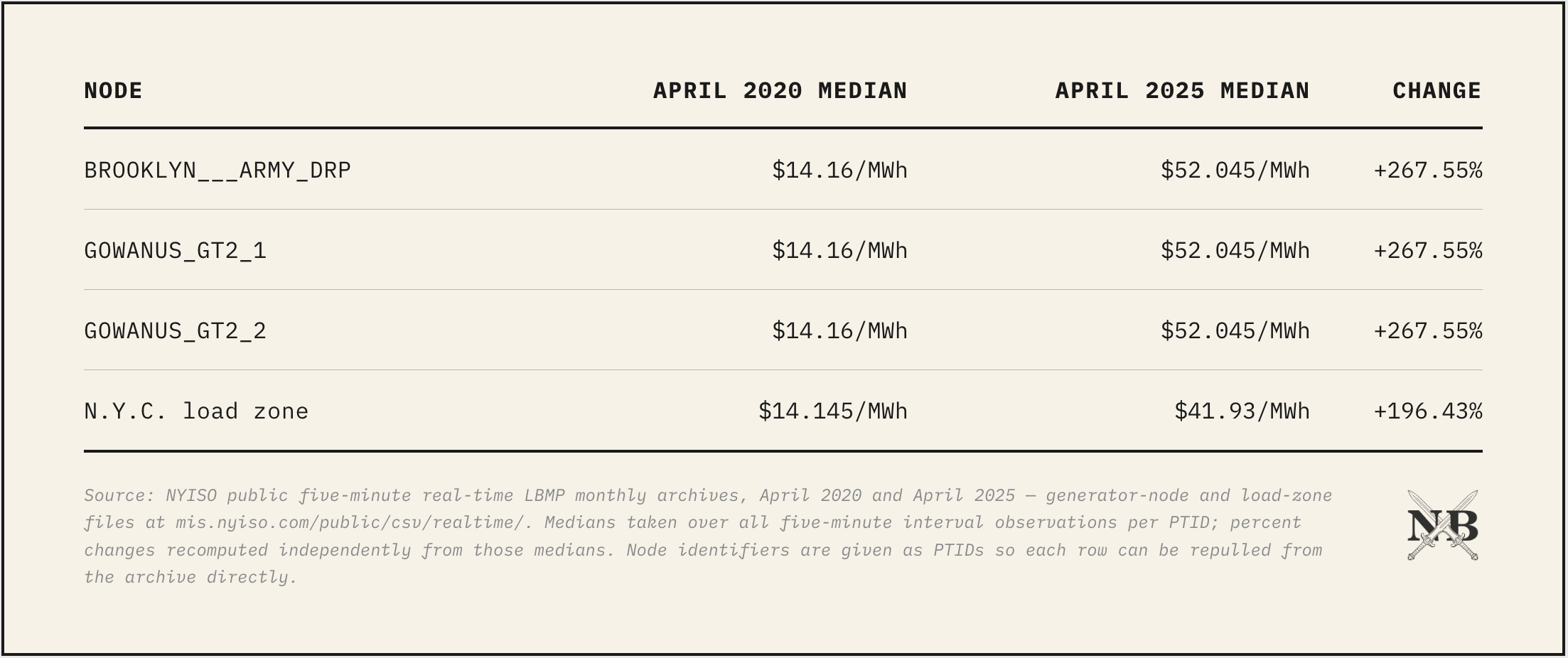
In short, an urban cluster of nodes around Brooklyn. So, Bloomberg’s Leap™ is real—at least, real in Brooklyn.
But let’s take a second look at Bloomberg’s time-scale. April 2020. What was going on in April of 2020? It wasn’t the start of a great data center buildout, but it was a very special month.
Covid, anyone?
April of 2020 is also the lowest priced month in recorded EIA history since 2001. Even a return to normal would look like a spike by comparison, let alone accommodating massive data center demand.
Speaking of, how much data center demand came online at this node between April 2020 and April 2025? Turns out, the analysis didn’t even check.
There are about 95 live data center facilities within 50 miles of the Brooklyn node, totaling 613 MW of capacity.
But almost all of those data centers were built before 2020. These are old school servers, built for the digital services of America’s largest city. Only 10.2 MW of new data center demand hit that region between the Aprils of 2020 and 2025.
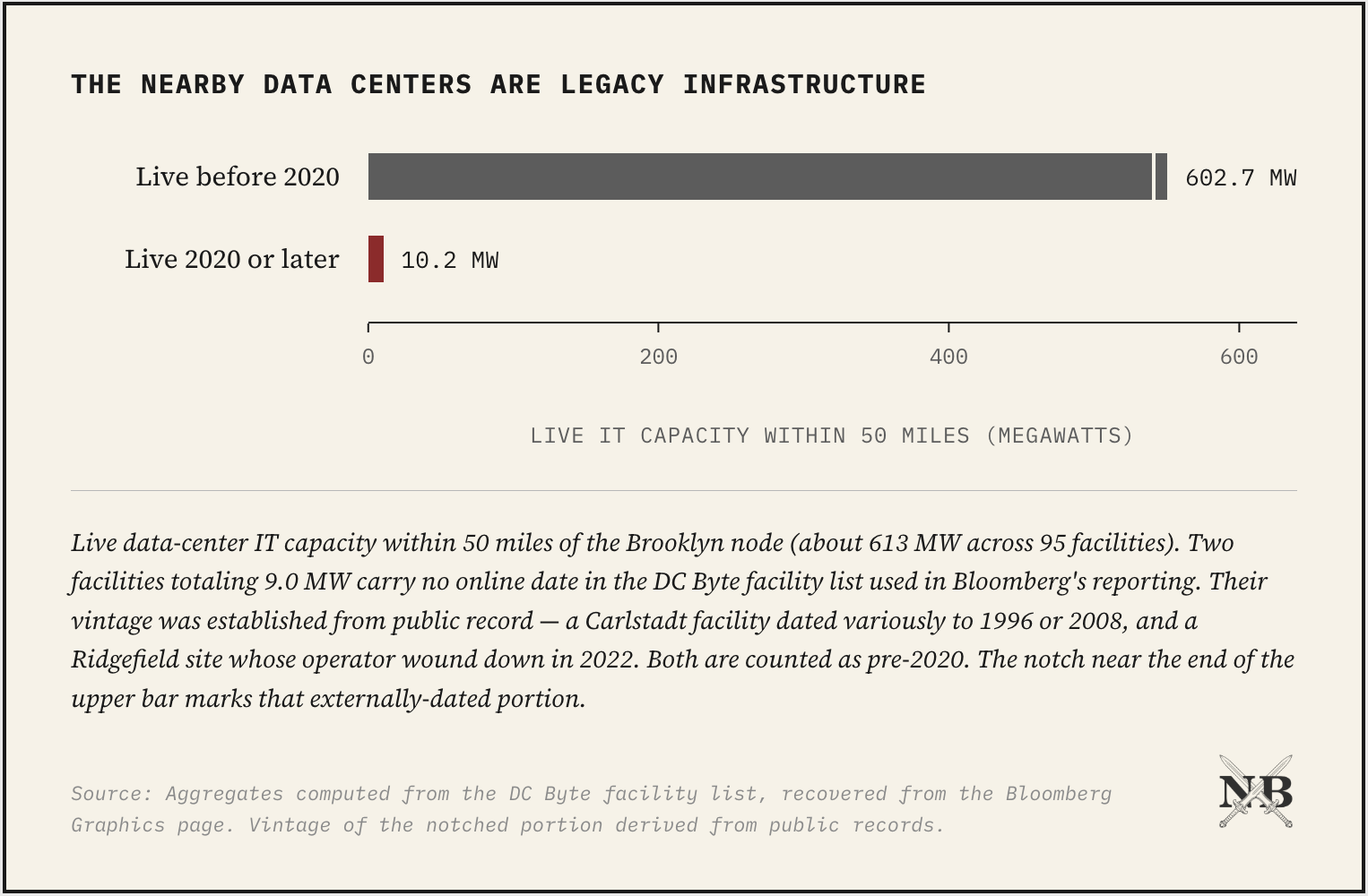
For scale, many data centers in the construction pipeline are two orders of magnitude bigger that the 10.2 MW of data center demand added to the Brooklyn node after 2020.
But in this time period, a big change did ripple across this region. Less than 50 miles away, Indian Point was sending NYC 2,000 MW of power. Then it stopped. When the plant shut down (Unit 2 in April of 2020; Unit 3 in April of 2021), NYC lost vital baseload power 200 times greater than data center growth in this region.
That plummet in power supply left NYC vulnerable to wholesale price increases. Thus, Bloomberg confused a supply shock for a demand signal and then saddled data centers with the blame.
That’s a shame, because the currently available data says otherwise. Data centers have had a largely salutary impact on prices, while bad policies have driven up people’s bills (as I have been saying!).
Gov. Hochul has big ambitions for nuclear power in New York. But it’s the “hyperscalers” building data centers who have become the largest investors and strongest supporters of nuclear power in the country. It’s their contracts, their demand, and their willingness to pay more for firm and clean power that’s driving the nuclear renaissance.
A year-long moratorium misidentifies data centers’ role in the power sector. Data centers are fundamentally new ratepayers. They pay their bills and have shown a tremendous willingness to pay more: for speed, for clean energy, and for firm power.
So, if Gov. Hochul and the Empire State aimed to refuge their constituents from rising power prices and invest in their grid, they made the exact wrong decision.
In fact, New York is liable to lose out on a massive influx of capital, an economic shot in the arm for any community that hosts a data center. Just take a look at “Data Center Alley” in Loudoun County, Virginia, where the data center boom has brought in $1 billion a year in tax revenue, around 45 percent of the county’s total tax revenue.
Other examples stand out. Consider Meta’s Richland Parish data center expansion in Louisiana. Thanks to the buildout, teachers will receive bonuses up to $50,000, a 400 percent increase from the previous year. That’s just one item out of a whole raft of related benefits.
And then there’s Google’s impact on Oklahoma, which Senator Markwayne Mullin (now Sec. Mullin) described as a “game changer” for the state’s infrastructure and education systems. Google’s $15 billion buildout has provided rural Oklahomans with billions in associated economic activity.
Hochul may think that initiating a brief pause in her state’s data center surge will help align stakeholders, but opportunities like the above will pass her constituents by in the meantime. And the odds that this one-year moratorium hardens into a general ban are far from non-zero.
Here’s the punchline: the data center boom has forked the future along two paths—the way of “No” and the way of “Yes.”
“No” is simple, easy, demands little thought in the way of trade-offs. Like nursing resentments, “no” offers the illusion of empowerment whilst maintaining the reality of the status quo. Perhaps that explains why the data center backlash is so often driven by diffuse anger, “vibes,” and sloppy analysis.
“Yes,” on the other hand, demands work: negotiation, forethought, and prudence. It requires steel and iron; land and heat and toil. But “yes” brings with it generational prosperity.
Zooming out to assess the national picture, it’s hard to pinpoint any other dynamic that’s shaping American politics more profoundly than these forking paths over the next ten years.
Choose wisely.
Great analysis, thanks emmet
Excellent analysis, exposing Bloomberg's careless, narrow, cherry-picked, short-sighted view.
Here's the important summary:
"But in this time period, a big change did ripple across this region. Less than 50 miles away, Indian Point was sending NYC 2,000 MW of power. Then it stopped. When the plant shut down (Unit 2 in April of 2020; Unit 3 in April of 2021), NYC lost vital baseload power 200 times greater than data center growth in this region.
That plummet in power supply left NYC vulnerable to wholesale price increases. Thus, Bloomberg confused a supply shock for a demand signal and then saddled data centers with the blame.
That’s a shame, because the currently available data says otherwise. Data centers have had a largely salutary impact on prices, while bad policies have driven up people’s bills (as I have been saying!)."
Figures don't lie, but liars can figure. Bloomberg's figures were, in effect and for all practical purposes, lies.